

DialogueON: Water Sustainability

On Monday 17th August, Open Dialogues International hosted our monthly themed dialogue event titled ‘DialogueON: Water Sustainability’. As climate change intensifies droughts, floods, and water insecurity around the world, access to safe and sustainable water is becoming a key global challenge. We have all seen first hand the impact of poor water resilience planning over the summer months.
The conversation examined how communities and governments can work together to understand the importance of our water sources. We also asked what practical actions we can take to build long-term resilience.

Ruby's Insights on Water, Planning, and Hope
We welcomed our first fantastic speaker: Ruby Lang! Ruby is a water resources engineer who works on water system planning, drought resilience, and regulatory compliance for communities across the western United States. She focuses on helping systems prepare for uncertainty, invest wisely, and remain reliable in a changing climate.
Drawing on her experiences in water planning, Ruby emphasized the need to plan for multiple possible water futures. She highlighted the importance of asking what could happen rather than relying on historical patterns. In her words, “what happens when we stop treating the future as something we are waiting for, and start treating it as something we can plan for?”.

Her main goal is to understand where a system is vulnerable and to make decisions that stay useful even when our assumptions turn out to be wrong. These decisions look different for every community, business, individual, and household.
Ruby also raised an important point: some parts of the future are conditions we have to prepare for, like droughts or wildfires, but others are shaped by the choices we make today. Water sustainability decisions must consider both factors.
Alex's Insights on Water and Development
Our second speaker, Alex Herrlin, built upon these themes. Alex is a student of Global Sustainable Development (GSD) at the University of Warwick, where she focuses on the intersection of economic, social, and environmental sustainability factors. She also supports ODIF through our partnerships, outreach and communications work.
Alex pushed participants to consider the development decisions that are being made today. She highlighted the need to consider water alongside infrastructure, technology, and urban planning, including the growing water demands associated with AI through data centres.
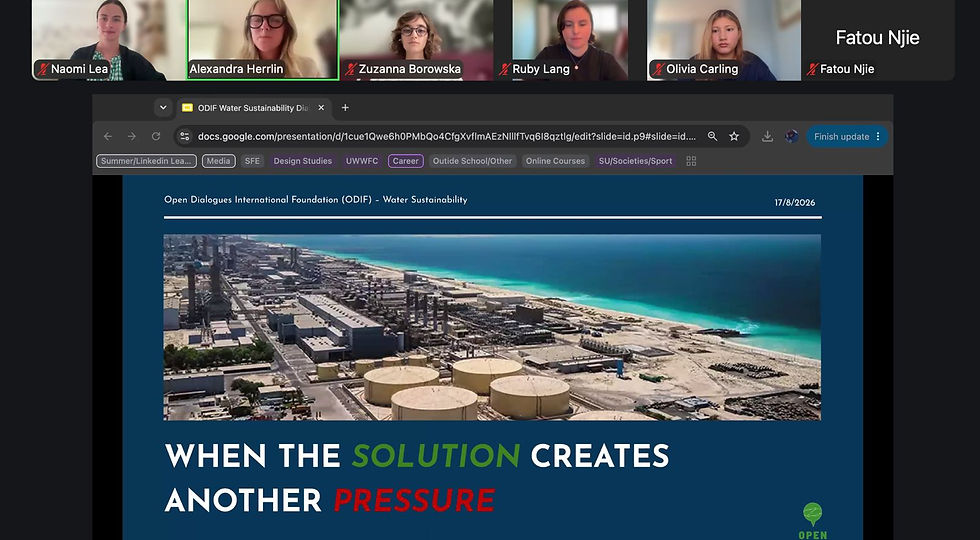
She also pointed out the trade-offs involved in solutions such as desalination. While this process can provide essential freshwater, it also creates wider environmental impacts. Water resilience depends on how we design our cities, determines our patterns of consumption, and connects to a broader collective choice about our water systems. We cannot think about water in isolation.
Dialogue
The discussion that followed explored the growing relationship between climate change and water security. Participants emphasized that water must be understood as an environmental concern, but also as a foundation for health, food security, and economic livelihoods.
Several participants highlighted the increasingly unpredictable nature of water availability as climate change intensified changing rainfall patterns. Communities face greater extremes and uncertainty, making it essential to plan for larger emergencies. Participants also noted the importance of inclusive water governance and equitable access to safe, affordable water. The discussion centred around local knowledge to develop sensitive response and adaptation plans.
A recurrent theme was the need to move beyond short-term emergency responses towards long-term climate resilience. Participants exposed gaps in infrastructure, financing and water management. Community involvement was seen as essential to ensure that local needs are reflected in development initiatives. Others also stressed the importance of protecting water sources from pollution and addressing wider environmental challenges such as plastic waste.
Overall, there was strong agreement that water should be treated as a core climate and development priority, with greater investment needed as the planning stage to ensure resilient access to water.

Final Thoughts
The session concluded with our speakers’ final comments. Water must be placed at the forefront of climate decisions. Communities must have a meaningful role in shaping water decisions and the discussion on water must remain hopeful.
Rather than focusing only on the doom and gloom of water systems, the dialogue encouraged a shift towards asking what we can do to prepare. As Ruby stated during her presentation, “hope is not pretending the crisis is smaller, but giving us agency to plan for crises”.
Water resilience depends on the choices made today, from how cities are designed to how water is consumed. Water systems do not exist in isolation and neither do the decisions that shape them. By planning for uncertainty, we can create great resilience to shape more sustainable outcomes.
~Naomi Lea & Alexandra Herrlin


Comments